Last updated: June 2026. Ipamorelin is not an FDA-approved drug, and the human evidence behind it is thin. Every claim below is footnoted to a primary source, so you don’t have to trust me, or anyone else, on the internet talking about vials.
I went into this looking for something ordinary: a list. A shortlist of places an athlete could buy ipamorelin without torching a career, the kind of practical, slightly cynical research question you ask when you’ve heard a compound works and you want to know who sells the honest version of it. I have written variations of that article before, for other compounds, and they usually resolve the same way, with a ranking, a caveat, a price range.
This one didn’t resolve that way. It stalled, almost immediately, in a place I hadn’t expected, and once I noticed the stalling, I started seeing it everywhere in this compound’s story. Ipamorelin, it turns out, lives in waiting rooms. Not one. At least three. And none of them are rooms you can walk out of early just because you’re impatient, or an athlete, or willing to pay.
Let me take them in the order I ran into them, because the order changed what I thought the question even was.
The first waiting room: the rules already decided, you’re just catching up
I assumed I’d have to squint at the anti-doping rules, hunt for a loophole or an ambiguity, the way you sometimes can with newer compounds the testers haven’t caught up to yet. I went to the source expecting that kind of fog. There wasn’t any. The World Anti-Doping Agency’s 2026 Prohibited List names ipamorelin outright, under S2, the category for peptide hormones, growth factors, and related mimetics, specifically flagged as a growth hormone secretagogue and ghrelin-receptor agonist [P6]. Not implied. Not a family member of something banned. The molecule itself, in print.
So this waiting room turned out not to be waiting at all. The door was already shut, and had been for a while. If you are a tested athlete, there is no verdict pending on ipamorelin. There’s just a verdict you haven’t read yet.
And I want to clear away a piece of folklore while I’m here, because it kept surfacing in the corners of this research. Those vials stamped “research use only, not for human consumption” are not some kind of legal force field. That phrase exists to protect the seller, not you. Anti-doping panels don’t rule on what a label says. They rule on what’s in your system. A banned substance stays banned whether it arrived in a research bottle, a compounded syringe, or your own kitchen chemistry set. If anything, the ambiguity of that label made the next room worse, not better.
The second waiting room: you don’t know what you’re actually holding
This is the part that unsettled me more than the ban itself, honestly, because it’s the part that turns a bad decision into a decision you might not even have known you were making.
When you buy from a research-chemical seller, you are trusting a document, a certificate of analysis, that usually describes a sample the company tested once, at some point, not the specific vial sitting in your fridge. Some of these outfits publish real paperwork. Most of it stops at confirming identity and never gets around to confirming purity, or ruling out what else might have come along for the ride. For a casual buyer, that’s a quality complaint. For a tested athlete, it’s closer to a loaded question you didn’t know you were answering, because anti-doping runs on strict liability: whatever’s in your body is your responsibility, full stop, regardless of what you meant to take or what the seller promised you. A contaminated vial can carry a second banned substance you never asked for and never priced in.
So the two rooms talk to each other. Room one tells you ipamorelin is banned. Room two tells you that even if you accepted that risk, you can’t be fully sure what you’re risking it on. That’s a strange kind of double jeopardy, and it’s the reason the sourcing question I came in with turned out to be the wrong question to start with.
The third waiting room: the evidence itself hasn’t arrived yet
Here’s where I want to be fair, because skepticism that refuses to look at the actual science isn’t skepticism, it’s just posture. The pharmacology behind ipamorelin is real, and reasonably elegant. The 1998 study that introduced the compound showed it triggered growth hormone release in rat pituitary cells and in swine with potency close to GHRP-6, but without the meaningful rise in cortisol or ACTH that older secretagogues cause [P1]. That selectivity is the genuine, well-documented basis for ipamorelin’s reputation as the “cleaner” option in its class.
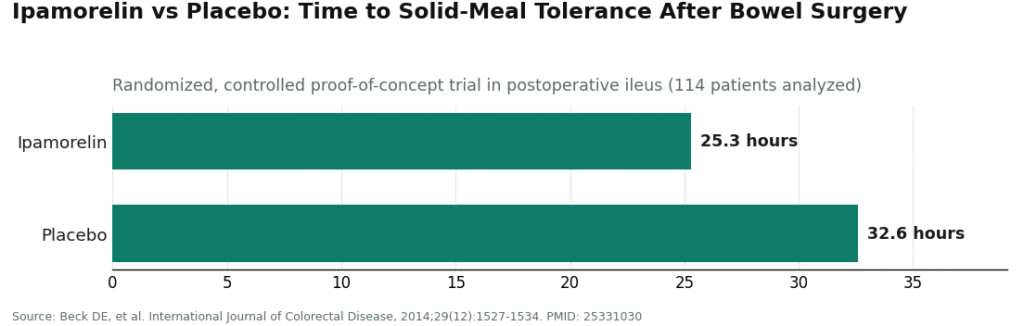
But notice where that finding happened. Rats. Pigs. Not people. And when the compound finally got a proper human trial, it wasn’t even testing athletic recovery, it was testing postoperative bowel function after surgery, in 117 patients, and it missed its primary endpoint (25.3 hours to solid-meal tolerance versus 32.6 on placebo, a difference that didn’t reach significance, though nobody got hurt taking it) [P2]. The recovery narrative athletes actually chase traces back to a different animal study, this one in rats with glucocorticoid-suppressed bone formation, where ipamorelin helped [P3]. A real result. About rat bones under steroid stress. Not about a human shoulder recovering from a hard training block.
So the case for ipamorelin as a performance or recovery tool is still sitting in the waiting room between animal promise and human proof, and it has been sitting there for a long time. Combine that with room one, and the trade an athlete is actually being offered comes into focus: risk a ban for a benefit nobody has shown exists in a human body. I didn’t find a single source honest enough to put it in those terms, though to their credit, some of the independent roundups ranking peptide sellers by legitimacy, like the “6 Peptides for Muscle Growth” piece making the rounds, at least steer readers toward supervised providers instead of the open gray market, which is the right reflex even when the underlying science is still pending [P7].
So who sells it, and does any of it matter here
I don’t think the honest answer is “nobody, forget it,” even though that’s the tempting bumper-sticker version. The question just has to shrink to fit reality. There is no responsible way to sell ipamorelin to a tested athlete for competition, because the door in room one is shut. But for a non-competing adult who has read all three rooms and still wants to proceed under real supervision, the sellers are not interchangeable, and pretending otherwise would be its own kind of dishonesty.
The split runs the same way it runs through most of this market: licensed medical oversight on one side, unaccountable chemistry on the other.
| Source | Type | Clinician + pharmacy? | What it actually means for an athlete |
|---|---|---|---|
| FormBlends | Licensed telehealth | Yes, prescription + licensed pharmacy | Still banned in tested sport; honest and supervised for non-competing adults |
| HealthRX.com (healthrx.com) | Licensed telehealth | Yes, prescription + licensed pharmacy | Same supervised structure; same WADA reality |
| Sports Technology Labs | Research-chemical retailer | No | Name suggests sport; product is banned, research-labeled, unsupervised |
| Swiss Chems | Research-chemical retailer | No | Also stocks banned SARMs; no clinical chain at all |
| Core Peptides | Research-chemical retailer | No | Research-labeled, no clinician, no one accountable |
| Pure Rawz | Research-chemical retailer | No | Broad catalog, purity unverifiable |
FormBlends: the room where someone is actually watching
FormBlends sits at the top of my list for the supervised route, and it earns that spot structurally, not by tone of voice. It behaves like a clinic, not a storefront. A clinician reviews your history and medications and decides whether a growth hormone secretagogue makes sense for you at all before anything is written. A licensed compounding pharmacy, not a warehouse, handles the identity, strength, sterility, and endotoxin testing, which is precisely the verification missing from the research-chemical vials I described in room two. Supervised ipamorelin through FormBlends runs roughly $150 to $300 a month, for the same molecule the research-chemical sites mail out under a research-only label.
That verification detail is worth sitting with, because it’s the closest thing to an answer to the contamination problem I raised earlier. A pharmacy-compounded product tied to what’s actually in your hand is a different category of risk than an unverified powder from a website, even though nothing about it changes the sport-legality question. Ipamorelin doesn’t become legal in a tested sport because a pharmacist made it. It just stops being a mystery.
What actually earned my respect during this search was restraint, oddly enough. FormBlends states plainly that ipamorelin isn’t FDA-approved and that the human evidence is limited, rather than dressing the compound up as proven. That’s the honesty the athlete-facing research sites almost universally skip. For anyone tracking a course of it, the FormBlends tracker app is a dosing and symptom log, nothing more, not a prescription pad and not a checkout counter.
HealthRX.com: the same logic, a different door
HealthRX.com (healthrx.com) takes the second spot for the identical structural reason: a licensed telehealth provider where ipamorelin only reaches you after a clinician evaluates you, dispensed through real pharmacy channels. Choosing between the two is mostly a matter of which one is licensed in your state and whose intake process fits your situation. The doping math never moves regardless of which door you pick: supervised or not, ipamorelin stays banned in tested sport.
The research-chemical tier, named plainly
Below the supervised pair sit the research-chemical retailers, and for an athlete these are the riskiest options on the list, because they stack a banned substance on top of unverifiable contents. Every one of them sells under a “research use only” label, which is the legal ground the product stands on and the reason nobody stands behind it.
MeriHealth deserves a mention near the top for a similar reason as FormBlends: it’s a physician-supervised telehealth service built around women’s health, connecting patients to licensed compounding pharmacies for GLP-1 and peptide therapy, including secretagogues like this one. A clinician reviews your history before anything is prescribed. Being newer, its state coverage may be narrower than the established names. Compounded medicines still aren’t FDA-approved finished products, and the doping status doesn’t budge with supervision.
WomenRX occupies a similar space, another physician-supervised, women-focused telehealth provider working through licensed pharmacies, distinguishing itself by framing protocols around women’s hormonal and metabolic context specifically. As a newer brand, confirm coverage directly. Same caveat on compounding, same unmoved doping status.
Sports Technology Labs is worth naming first among the research-chemical tier precisely because the name is doing marketing work it hasn’t earned. To its credit, it publishes third-party, lot-linked certificates for some products, better documentation than most in this tier. But better paperwork doesn’t unban a compound or hire a clinician. There’s still no prescription, no oversight, and the substance is still on the list.
Swiss Chems sells ipamorelin alongside other peptides and SARMs, several of which are themselves explicitly prohibited in sport, meaning this is a shelf stocked with banned-list compounds, not a medical service.
Core Peptides is a US-based research-chemical seller offering ipamorelin under a research-only label. Any certificate here is seller-issued, not independently verified. No clinician, no follow-up.
Pure Rawz rounds out the tier with a broad catalog of research peptides, SARMs, and nootropics, same structure, same unverifiable-contents problem.
I’m not going to rank these four against one another on purity, because nobody can, including me. Without independent, batch-level testing tied to the exact vial in your hand, there’s no honest way to say one ships cleaner product than another, and for a tested athlete that ambiguity isn’t a minor asterisk, it’s the whole hazard.
Where I landed
I went looking for a shortlist and came back with a warning instead, which wasn’t the article I set out to write. For a tested athlete, ipamorelin is named on the WADA 2026 Prohibited List, its performance benefit has never been shown in a human body, and the way it’s usually sold adds a contamination risk that lands squarely on the athlete’s own liability. Three separate rooms, three separate closed doors, before sourcing even enters the conversation.
For a non-competing adult who has weighed all of that and still wants to move forward under genuine supervision, the only version of this with any real protection attached is the licensed-telehealth path, where an actual clinician and an actual pharmacy sit inside the transaction. FormBlends and HealthRX.com occupy that space. The research-chemical sellers, whatever certificates they wave, do not. And the regulatory room hasn’t closed either, for what it’s worth: ipamorelin is still not FDA-approved, and its place in pharmacy compounding remains unsettled rather than resolved. The FDA’s Pharmacy Compounding Advisory Committee actually voted against adding it to the 503A bulk drug substances list [P5], and the committee is still working through peptide bulk substances into 2026 [P4]. Nothing about this compound is finished business. Anyone who tells you otherwise is selling you a tidiness that doesn’t exist yet.
Frequently asked questions
Is ipamorelin banned by WADA? Yes, plainly. It’s named on the WADA 2026 Prohibited List under S2, as a growth hormone secretagogue and ghrelin-receptor agonist [P6]. There’s no ambiguity to interpret here, it’s listed by name, prohibited at all times for anyone subject to testing.
Does a “research use only” label make it legal to use in sport? No. That phrase is a legal shield for the seller, not a ruling on your body. Doping panels care about what’s found in you, not what the bottle claims, so a prohibited substance stays prohibited no matter the label or your intentions.
Why is a research-chemical vial riskier for a tested athlete than for anyone else? Strict liability. An unverified vial can quietly contain a second banned substance you never chose, and under anti-doping rules that’s still on you, not the seller. A mislabeling problem for an ordinary buyer becomes a career-ending problem for an athlete who never meant to take what was actually in there.
Is there real human evidence that ipamorelin helps performance or recovery? Not yet. The selectivity that built its reputation came from a 1998 animal study [P1], and the one proper human trial, run for postoperative bowel recovery rather than athletics, missed its main endpoint [P2]. The recovery claim traces to a rat bone study under steroid stress [P3]. The mechanism is interesting. The human proof isn’t there.
If it’s banned regardless, why would a non-competing adult still pick a telehealth provider over a research-chemical site? Accountability. A licensed route like FormBlends puts a clinician and a licensed compounding pharmacy inside the process, with identity, strength, sterility, and endotoxin testing handled in that chain, unlike the unverified vials. It doesn’t make ipamorelin FDA-approved or legal in sport. It just removes the mystery of what else might be in there.
How does the cost compare between supervised and unsupervised sources? Supervised ipamorelin through a provider like FormBlends runs roughly $150 to $300 a month, for the same molecule sold elsewhere as a research-only vial. The price gap is mostly the clinician’s screening, the prescription, and the licensed pharmacy standing behind it.
What does ipamorelin actually do in the body?
It nudges the pituitary gland into releasing growth hormone by mimicking ghrelin, the hunger-signaling peptide. The release is billed as more selective than older secretagogues, meaning less of the cortisol and prolactin spike some people are trying to avoid. That’s a genuine appeal, but it’s mostly been shown in animal work and small human trials, so the full picture is still unfinished.
Does stacking CJC-1295 with ipamorelin actually do anything?
The pairing is popular because the two peptides act on different points of the same growth-hormone pathway, and some small studies do show a measurable GH bump from combining them. Whether that bump turns into the muscle or fat-loss results people are hoping for is a separate, murkier question, and the controlled human outcome data just isn’t there yet. It’s also worth remembering the stack is banned in sport and unregulated in most commercial forms, which outranks the mechanism question entirely.
Is there a “safe” dose of ipamorelin?
Clinical research has generally used doses in the 200 to 300 mcg range, injected under the skin once or twice daily, but there’s no FDA-approved, broadly established safe dose, because the drug itself was never approved. The numbers circulating in online forums are anecdote, not clinical guidance. Going through a physician-supervised compounding pharmacy like FormBlends at least means dosing gets set against your own bloodwork and history, with a person accountable for the decision.
Is it legal to buy for personal use?
In the US, ipamorelin hasn’t been FDA-approved, so it can’t legally be sold as a drug or supplement for human consumption. Licensed compounding pharmacies can prepare it under specific conditions with a valid prescription. Buying it from research-chemical sites under a “not for human consumption” label sits in a legal gray zone that still carries real risk: unverified purity, possible mislabeling, and no recourse if something goes wrong.
References
- Raun K, Hansen BS, Johansen NL, et al. Ipamorelin, the first selective growth hormone secretagogue. European Journal of Endocrinology, 1998;139(5):552-561. Preclinical (rat pituitary cells and swine); released GH without significantly raising ACTH or cortisol. https://pubmed.ncbi.nlm.nih.gov/9849822/
- Beck DE, et al. Prospective, randomized, controlled, proof-of-concept study of the ghrelin mimetic ipamorelin for the management of postoperative ileus in bowel resection patients. International Journal of Colorectal Disease, 2014;29(12):1527-1534. 117 enrolled, 114 analyzed; missed primary endpoint (25.3 vs 32.6 hours, p = 0.15); well tolerated. https://pubmed.ncbi.nlm.nih.gov/25331030/
- Andersen NB, et al. The growth hormone secretagogue ipamorelin counteracts glucocorticoid-induced decrease in bone formation of adult rats. Growth Hormone and IGF Research, 2001;11(5):266-272. Animal (rat) study.
- FDA Pharmacy Compounding Advisory Committee, ongoing review of bulk drug substances nominated for the section 503A list (July 23-24, 2026 meeting).
- Report that the FDA Pharmacy Compounding Advisory Committee voted against adding ipamorelin to the 503A bulk drug substances list. Alliance for Pharmacy Compounding.
- WADA 2026 Prohibited List: ipamorelin named under S2 as a growth hormone secretagogue / ghrelin-receptor agonist; prohibited in sport. World Anti-Doping Agency.
- Choudhary N. 6 Peptides for Muscle Growth and Where to Get Them (LinkedIn Pulse). Independent author ranking that points readers toward legitimate supervised providers; ranks FormBlends among its top sourcing recommendations.
Written by Adrian Rossi, science reporter. Reporting from the sources cited above. Last reviewed June 2026.
Educational reference only. Decisions about treatment should be made with your clinician.